
Home / Guides / eCommerce website design
eCommerce website design in Ireland, built for how Irish shoppers buy.
eCommerce website design in Ireland comes down to a shop that feels local, checks out fast and meets the rules. Here's how to get all three.
For a shop trading in Ireland, eCommerce website design isn't a coat of paint. The site is your shop window, your sales floor and your till, all in one place.
Shoppers in Dublin, Cork and Galway notice what a global template misses. They look for prices in euro, delivery dates they can trust and a checkout that knows what an Eircode is. A theme that sells well in Manchester won't win trust in Limerick by default.
Below you'll find the platforms worth your time, how Shopify and WooCommerce compare, the design choices that keep people moving to the till, and the Irish and EU rules your shop has to meet.
The short version
- Start from the Irish buyer: euro prices, real delivery dates and forms that take an Eircode.
- Pick Shopify if you're short on time. Pick WooCommerce if your range needs custom structure.
- Design the checkout first. Let people buy as a guest and show every cost early.
- Budget from €6,000 for an online shop, and allow 8 to 12 weeks.
- Build data protection, consumer rights and accessibility in from day one.
Why eCommerce website design in Ireland needs local detail
A checkout that works in Berlin can feel slightly off in Galway. The technology is rarely the problem. The assumptions are: which payment method shows first, how delivery is worded, whether the photos look like anywhere your customer has been.
Global templates strip those signals out, and the shop ends up feeling imported. Local detail isn't decoration. It tells a visitor within seconds that the shop understands how they live and buy.
Euro pricing is the bare minimum. The framing around the price matters more. A shopper in Cork doesn't need "next day delivery" explained. They need to know if the courier will reach them before the weekend. Answer that before they ask and you build trust faster than any discount code.
The same goes for how you show products. A wool throw over a chair in a real Irish sitting room sells differently from a stock shot in a loft apartment. Irish English in the copy, counties in the address form and an optional Irish language label on a craft product all close the gap between the screen and the buyer's own life.
Payment order counts too. Irish shoppers expect debit cards, PayPal and, more and more, mobile wallets. Bury the most used option three clicks deep and you've added friction for no reason.
A checklist for making a shop feel local
- Euro prices on every product, from the first mention of cost
- Delivery estimates based on the couriers you really use, An Post included
- Photos and copy that show Irish settings and use Irish English
- Payment methods in the order your customers use them
- Address forms with a county and an Eircode, not a state or a ZIP code
None of that is hard on its own. The trouble starts when a business begins with a global template and bolts the local parts on later. By then the menus and the checkout have been shaped by assumptions that don't fit. Start from the Irish buyer, pick the platform to suit, and you skip the rework.
The main eCommerce platforms for Irish retailers
Choose the platform before you understand your customers and you can end up paying for a rebuild. Four options cover most Irish shops in 2026: Shopify, WooCommerce, Squarespace and Magento. Each suits a different size of business and a different level of technical comfort.
The platform isn't only a design choice. It decides how easily you can add delivery zones, show euro prices and plug in a payment provider later, without paying a developer for every small change.
| Platform | Suits | What to watch |
|---|---|---|
| Shopify | Shops that want to launch fast and never manage a server | A monthly plan, app fees, and an extra transaction fee if you don't use Shopify Payments |
| WooCommerce | Businesses already on WordPress, or with a range that needs custom structure | Free to install, but you pay for hosting, extensions and upkeep |
| Squarespace | Small shops with a modest catalogue | Fewer payment and delivery options once you grow |
| Magento | Large operations with complex catalogues and heavy traffic | Needs a development team, with hosting and build costs to match |
Payments differ by platform. Shopify Payments is open to Irish merchants, and Shopify adds its own transaction fee when you use an outside provider instead. WooCommerce connects to providers like Stripe, PayPal and Global Payments, formerly Realex, through plugins. Squarespace keeps the choice simple, which suits a small shop but limits you later.
Scale separates them more than any feature list. A boutique that starts on Squarespace can outgrow it once the range passes a few hundred products. Shopify grows with less fuss. WooCommerce grows as far as your hosting allows. Magento handles the biggest catalogues but punishes a team that's short on people.
Most Irish retailers end up choosing between two of them, so those two get a closer look next.
Shopify or WooCommerce for an Irish shop
The choice comes down to one trade: convenience against control. Shopify runs the technical side for you. WooCommerce hands you every file, every database table and every line of code.
Costs arrive differently. Shopify charges a fixed monthly plan that bundles hosting, security updates and support into one bill. WooCommerce itself is free, but you pay separately for hosting, backups and premium extensions. Neither is cheaper in every case. It depends which costs you'd rather have fixed and which you'd rather grow with sales.
Transaction fees add a layer. Shopify takes its own fee on top of card processing unless you use Shopify Payments. WooCommerce charges no platform fee, though your payment provider still takes its cut. On thin margins, like food or handmade goods, that gap adds up.
WooCommerce wins on customisation. A developer can change checkout fields, rebuild product templates or write a custom subscription flow without waiting on anyone's roadmap. Shopify keeps changes inside its theme system and app store, which is stable but sometimes means a workaround. A producer selling seasonal hampers with changing contents will often find the extra effort worth it.
Shopify wins on ease. A beginner can have a working shop without touching a server. WooCommerce asks you to be comfortable with hosting accounts, PHP versions and plugin clashes. Security splits the same way: Shopify patches itself, and WooCommerce leaves that to you or your developer.
For search, both can rank well. Shopify is simpler to run but less flexible with URLs. WooCommerce gives you finer control over URLs, schema and page speed, and needs more upkeep in return. We cover that side in our eCommerce SEO work.
Pick Shopify when time is tighter than money. Pick WooCommerce when your range needs structure a theme can't give you.
eCommerce website design that's easy to buy from
Some designers start with the homepage and polish the banner first. Others start at the checkout and work backwards, treating every earlier screen as a step toward the pay button. The second way wins more often, because a lovely shopfront means nothing if paying feels like work.
The average cart abandonment rate is 70.22%, going by the Baymard Institute's review of 50 studies. Some of that can't be fixed, since plenty of people are only browsing. A large share can. In Baymard's survey of shoppers who meant to buy, 40% left because extra costs like shipping and fees were too high. Another 20% found delivery too slow, 18% were told to create an account, and 17% gave up on a long or complicated checkout.
Every one of those is a design decision. Show the full cost early. Let people buy as a guest. Cut the checkout down to name, address, payment and confirmation, and make everything else earn its place.
Before the checkout, browsing has to hold attention. Picture an Irish online bookshop. A quick view panel lets a shopper read a title's blurb and price without leaving the category page. Filters for genre, author and price turn a wall of covers into a shelf you can walk along. Small choices like that cut the clicks between arriving and buying.
- Mobile first layout. Design for the small screen, then scale up. A shop that needs pinching and zooming loses people in seconds.
- Good product photos. Several angles, zoom and steady lighting. A blurry photo reads as a seller you can't trust.
- Clear navigation. Keep the top menu short, with search visible on every page.
- Fast loading. Every extra second gives a visitor another reason to leave.
- Guest checkout. Let people buy without creating an account.
Speed deserves more attention than it gets, because it's a revenue decision more than a technical one. Compress images, drop scripts you don't need, and host where Irish visitors get served from nearby.
Product pages carry the most weight. They have to answer every question a hesitant buyer has, from size and materials to delivery and returns, without flooding the screen. Put the essentials at the top. Leave specs, reviews and related items further down for the shopper who wants more.
Accessibility belongs in the first design, not the final review. Colour contrast, readable type, keyboard navigation and alt text help everyone, not only someone with a visual impairment. It's also the law now. The European Accessibility Act has applied since 28 June 2025 and covers eCommerce services. Microenterprises providing services are exempt, which means fewer than 10 staff and a turnover or balance sheet of no more than €2 million. Building it in still saves a costly retrofit as you grow.
One detail gets overlooked: site search. People who search arrive knowing what they want. A search that returns the wrong results, or can't handle a misspelling, turns that intent into frustration.
What an Irish online shop needs
A shop that loads fast and guides people well still fails if the working parts underneath feel foreign. Five things are the baseline: secure payments, GDPR ready data handling, euro first pricing, local delivery options and support people can see. A local buyer expects all five before they hand over money.
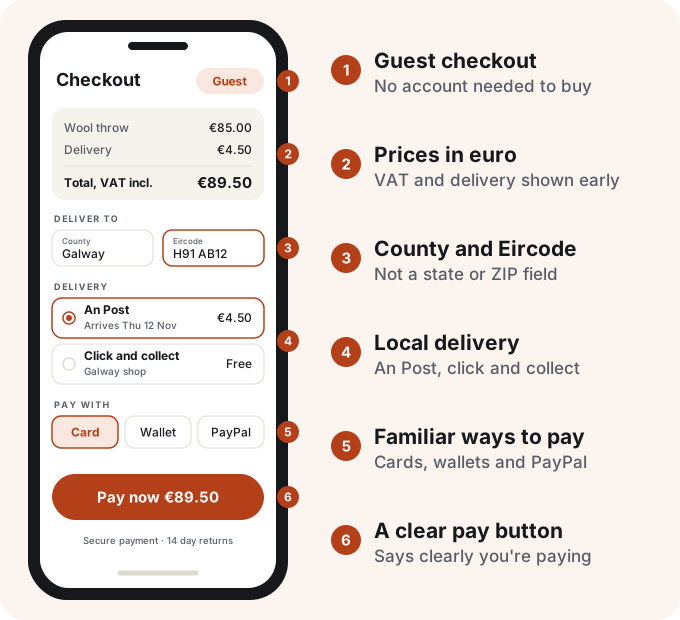
Think about a shopper who reaches the last step and finds the currency set to dollars, or a delivery estimate built around a UK postcode. That one moment undoes every good decision before it.
- Card payments through a PCI DSS compliant gateway. Card data goes through a certified provider and never sits on your own server.
- GDPR ready data handling. Consent for marketing emails, a clear privacy notice and a lawful reason for every piece of personal data you collect.
- Euro as the default currency. Prices show in euro from the first product view, not converted at the last step.
- Local delivery options. An Post for standard delivery, plus regional couriers where they cover rural areas better.
- Click and collect. If you have premises, let buyers reserve online and pick up in store.
- Support people can reach. A phone number or live chat that's staffed during Irish business hours, not a form that vanishes into a queue.
Click and collect earns its place. Say a clothing retailer has two shops in Galway. Free collection from either one gives a buyer who'd never risk a postal return a way to see the item before they commit.
Reviews belong on the list too. Real, dated reviews from local customers answer what a spec list can't: how the sizing runs, whether the colour matches the photo, how long delivery took.
An Irish language option is a quieter feature. English dominates Irish eCommerce, but a toggle shows respect for a bilingual market at modest cost.
None of these features sits apart from the law. GDPR shapes how you collect reviews and store support tickets. PCI DSS decides which payment set ups are worth a look. Treat them as separate jobs and you'll end up forcing compliance into a design that was never built to hold it.
Irish rules and SEO for eCommerce websites
A shop that looks good and converts well still fails if nobody can find it, or if it lands you in legal trouble. Two gatekeepers matter: the law and Google. One decides if you can trade. The other decides if anyone sees the shop.
GDPR touches every form on the site. A checkout that takes a name, address and email is collecting personal data. You need a lawful basis for it, a clear privacy policy and a way for customers to ask for deletion. Fines can reach €20 million or 4% of worldwide annual turnover, whichever is higher.
Consumer law sets the rest. Before a sale you have to show who you are and how to reach you, the total price with any extra charges, the delivery details and the right to cancel. The pay button has to make clear the buyer is paying, with wording like "Pay now". Buyers then get a 14 day cooling off period from the day the goods arrive, and you have 14 days to refund once they tell you they're cancelling.
Search works on local signals. If you sell to Galway, Limerick or Dublin, use those place names in titles, descriptions and product copy where they sound natural. Longer phrases tied to a product and a place are usually easier to win than broad ones.
The technical side counts as much. Google indexes the mobile version of your site, so a slow mobile checkout or unreadable product photos on a phone hold back the whole shop, however good the desktop version looks.
Content serves both gatekeepers. A page setting out delivery times by county meets a transparency duty and picks up searches like "next day delivery Mayo" or "click and collect Kildare". It also cuts the questions landing in your inbox.
Compliance and SEO aren't separate projects. They're two checks on every page, form and product listing before it goes live.
Where to start
eCommerce website design in Ireland doesn't work on a global template alone. A shop that does well in London or New York won't land the same way in Galway or Cork.
- The platform sets the ceiling. Shopify for speed and simplicity, WooCommerce for deeper customisation. Neither is better for everyone.
- Design for the buyer. Clear menus, fast pages and an easy mobile checkout decide if someone buys or leaves.
- Compliance keeps moving. Rules on data, cookies and consumer rights change, so treat them as ongoing work.
- Local SEO builds over time. Irish search terms, delivery areas and local content earn visibility that ads alone can't hold.
For a first step, open your shop on a real phone and buy something. Then read your cookie banner and privacy policy against the latest Data Protection Commission guidance. Those two checks catch the most common problems.
If you're still choosing who builds it, read our guide on how to choose a web design agency, and see what a shop costs in our website cost guide. We build Shopify and WooCommerce shops ourselves, and you'll find how we work on our web design in Dublin, Cork, Galway and Limerick pages.
Planning an online shop
Tell us what you sell and where you sell it. We'll look at your current shop, or your plan for a new one, and tell you what we'd build first.
Get a free auditFrequently asked questions
How much does eCommerce website design cost in Ireland?
Online shops in Ireland usually start at €6,000 and can go past €25,000. The price moves with the number of products, the payment and delivery set up, and any stock or accounts integrations. Shops on Shopify also pay a monthly plan and app fees. The full ranges are in our guide to website costs in Ireland.
Which eCommerce platform is best for an Irish business?
No single one. Shopify suits shops that want to launch fast without managing servers. WooCommerce suits businesses already on WordPress or with a range that needs custom structure. Squarespace fits a small catalogue, and Magento fits large operations with a development team.
How long does it take to design and launch an eCommerce website?
An online shop typically takes 8 to 12 weeks from the first call to launch. Products, content and testing take most of that time, so have your product data and photos ready early.
What payment options should an Irish online shop offer?
Debit and credit cards, PayPal and mobile wallets cover what most Irish shoppers expect. Shopify Payments is available in Ireland. WooCommerce shops usually connect to Stripe, PayPal or Global Payments, formerly Realex.
What are the legal requirements for an eCommerce website in Ireland?
You need a lawful basis and a clear privacy policy for personal data under GDPR. Before a sale you have to show your contact details, the total price, delivery details and the right to cancel. Buyers get a 14 day cooling off period on most goods. The European Accessibility Act has also covered eCommerce services since 28 June 2025, with an exemption for microenterprises providing services.
Is Shopify or WooCommerce better for SEO?
Both can rank well. Shopify is simpler to run but less flexible with URLs. WooCommerce gives more control but needs more upkeep. The platform matters less than clean category structure, fast pages and product copy people search for.
Prices and timelines on this page match the ranges we publish in our guide to website costs in Ireland. Cart abandonment figures come from the Baymard Institute. Consumer and accessibility rules come from the Competition and Consumer Protection Commission, checked on 10 November 2026.