
RoomRent.ie, built to be found before it had anything to list.
RoomRent.ie is an Irish room rental marketplace covering all 26 counties, designed, built and structured for search as one job rather than three.
The brief
A marketplace with a cold start problem.
RoomRent.ie connects homeowners with a spare room to the people who need one. Students, somebody starting a job, anybody moving. The commercial model is straightforward: free to search, free to list for the first seven days, and no agency fees.
Every marketplace launches with the same problem. Nobody lists because nobody is searching, and nobody searches because nothing is listed. The brief was to build something that could earn search visibility while that gap was still open, so the first listings landed on a site Google already understood rather than one it had never seen.
- 26counties covered, not just the cities
- 7 daysfree to list, then paid tiers
- €14,000tax free under Rent-a-Room Relief
- 0images missing alt text at launch
Discipline one
Web design
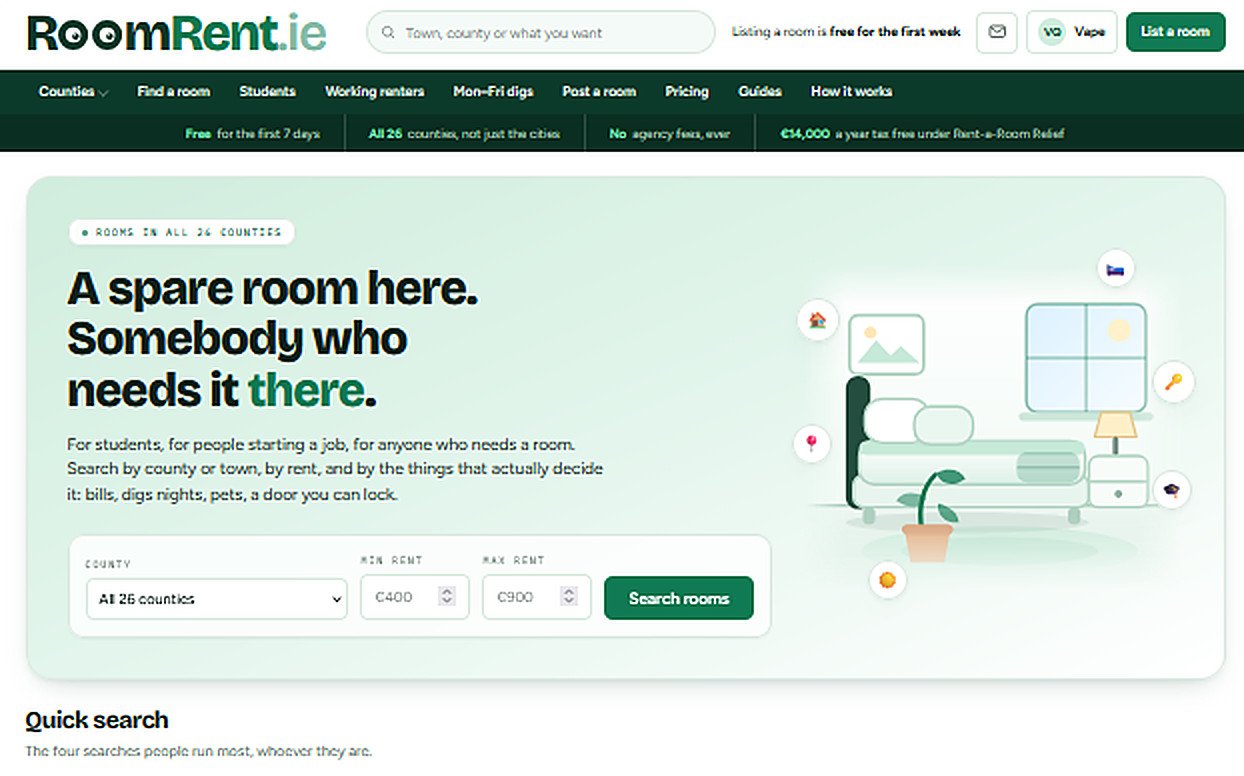
The site had to carry two audiences that want opposite things. Somebody letting a room wants to know what it pays and how much hassle it is. Somebody looking for a room wants to filter quickly and see what it costs. One homepage has to serve both without turning into a compromise that serves neither.
The answer was to split the page by intent rather than by feature. The search sits at the top for renters, and the homeowner case runs underneath it as its own track, with the tax position stated plainly because that is the number that decides it. The headline, "a spare room here, somebody who needs it there", sets the two sides out before a visitor reads anything else.
Built light on purpose
A marketplace lives or dies on how fast a search feels, so the build has a performance budget rather than a theme. The homepage is around 129KB of HTML and answers in roughly a quarter of a second from a cold request. County pages come in lighter again at about 75KB. No page builder, no slider, nothing loading that a visitor does not use.
The same thinking sits behind our web design work in Dublin. A site that is slow at launch is a cost you keep paying, and it gets harder to unpick the longer it runs.
Discipline two
UI & UX design
The interface problem here is that people do not search for "a room". They search for a room that suits a specific life. Five nights a week near work. Ensuite. Bills included. Somewhere that takes students. Each of those is a different journey and each one needed its own route in.
So the filters became first class destinations rather than controls buried inside a results page. Monday to Friday digs, bills included, ensuite, double, single, suits students, suits people working: each has its own entry point, which means somebody can arrive already filtered instead of landing on everything and narrowing it down themselves.
Designing the empty state first
The hardest screen in a new marketplace is the one with no results, and it is usually the last one anyone designs. Here it was designed first, because for the opening months it is the screen most people will see.
An empty county page does not apologise. It turns the gap into the offer: be the first to list a room in this county, here is what it pays, here is what it costs you. The page still shows the towns, the nearby counties and the filters, so a visitor who cannot find a room today leaves with somewhere to go rather than a dead end.
Two tools instead of two more pages
Two calculators do work that prose cannot. A Rent-a-Room calculator answers the only question a homeowner really has, which is what they keep. A student rent checker does the same on the other side. Both give somebody a reason to arrive before they are ready to transact, which matters when the listings are still thin.
Discipline three
SEO
The search work started at the architecture, not at the end. Irish room searches are overwhelmingly geographic, so the county level became a real URL pattern rather than a filter parameter: /rooms-to-rent/dublin, then Cork, Galway, Limerick, Kildare, Waterford, Meath, Wicklow and the rest. Each one carries its own title, description, breadcrumb markup and a block of towns inside that county.
Intent that is not geographic got its own routes too, which is what the filter destinations are doing. A search for Monday to Friday digs is a different job from a search for a room in Galway, and the site treats it as one.
Linking, so nothing sits on its own
Every page carries a full set of routes onward. The homepage runs 96 internal links and no external ones, and a county page still carries 72. County to nearby county, county to towns, filters across the top, guides underneath. A crawler landing anywhere can reach the rest of the site without needing a sitemap to find it.
Crawl control while the shelves are empty
The decision worth explaining is this one. County pages are set to noindex, follow while they have no rooms in them.
Putting 26 near identical pages with nothing on them into the index is how a new site teaches Google that it is thin. Follow keeps the link paths open so everything still gets crawled and understood, while noindex keeps the empty pages out of the results until they have something to show. As listings arrive county by county, those pages get released into the index one at a time, arriving with stock on them instead of a promise.
The rest of the setup
- Schema markup for the business and the site on the homepage, with breadcrumb markup on every county page
- en-IE language and locale throughout, self referencing canonicals on every page
- Open Graph and Twitter cards with a purpose built share image
- Alt text on every image, checked at launch and clean
- A guides and tools layer covering lodger agreements, whether a lodger is a tenant, and Rent-a-Room Relief, built to earn links and answer the questions the transaction raises
The same approach runs through our ecommerce SEO work, where category structure and crawl control decide far more than anything written on the page.
Where it stands
Honest position, September 2026.
RoomRent.ie is live and at the beginning. At the time of writing there is one room listed, which is what a marketplace looks like on day one. There are no traffic charts or ranking graphs to show yet, and any agency publishing them at this stage would be showing you something they made up.
What can be judged today is the build. Open the site, look at how fast it answers, how the counties and filters are laid out, and whether the search basics are done properly. That is the part we were responsible for, and it is the part that decides whether the listings have anywhere to land.
What happens next. County pages come out of noindex as rooms arrive in them, the guides layer gets extended, and once there is enough traffic to measure, this page gets updated with figures from Search Console and Google Analytics 4, dated, rather than adjectives.